
Why Can’t I Run My Genboostermark Code cannot be answered accurately from the name alone. First verify whether you have a real software project, a tutorial example or a code entered into a website, because each requires a different kind of help.
GenBoosterMark’s public homepage presents a marketing and technology information resource. It does not, by itself, supply a universal product specification for an executable tool. The practical approach is to identify your files, capture the failure and test only the requirements documented by a trustworthy project source.
Why Can’t I Run My Genboostermark Code: Define the Task
Begin with the GenBoosterMark homepage and the source from which you obtained the code. A website discussing automation is not automatically the developer of every script mentioned under its name. Look for a repository, named maintainer, README and explicit installation instructions before assuming a branded runtime exists.
Write one plain sentence describing your task. For example, you may be trying to run a downloaded Python script, reproduce an article’s example or enter a promotional token. That sentence is a useful filter: it stops you spending time on fixes that address a different meaning of code.
Make a Short Problem Note
Record the device and operating system, where the files came from and the exact action that failed. Copy the error text rather than writing only that it does not work. If the application closed without a visible message, note how you launched it and whether the documentation offers another supported method.
Keep passwords, customer information and tokens out of the note. You can replace a secret value with a clear placeholder while retaining the surrounding error structure. This creates something you can safely send to a maintainer or trusted colleague, and it prevents repeating the same incomplete explanation each time you ask for help.
Check the Instructions Before Changing the Computer
Read the project’s requirements from beginning to end, if a verified project exists. An example written for a particular runtime or operating system may not run unchanged elsewhere. Check the installation method, required version and any sample configuration rather than relying on a page that merely repeats the search phrase.
Do not interpret missing documentation as permission to try every suggested download. A trustworthy setup should explain where the software comes from and what it needs. If you cannot establish those basics, stop before executing unfamiliar files or entering credentials. The unanswered question is the identity of the software, not necessarily a defect in your laptop.
For Python, Confirm the Right Environment
If the files are genuinely Python, compare the interpreter selected in your editor with the one used by your terminal. The Python Packaging User Guide explains checking Python and invoking its package installer. A package installed into one environment may not help a script running in another.
Use inspection commands before installation commands. Check the version and the path information reported by the relevant tools, then compare them with the project requirements. Avoid replacing your system Python or changing global settings simply because an online troubleshooting page assumes every environment is identical.
Understand What the Error Is Telling You
Python’s errors and exceptions tutorial explains that an exception type and traceback provide clues about a failure. A syntax problem, a missing module and a file-path problem should not all receive the same remedy. Preserve the original error while you work through the relevant category.
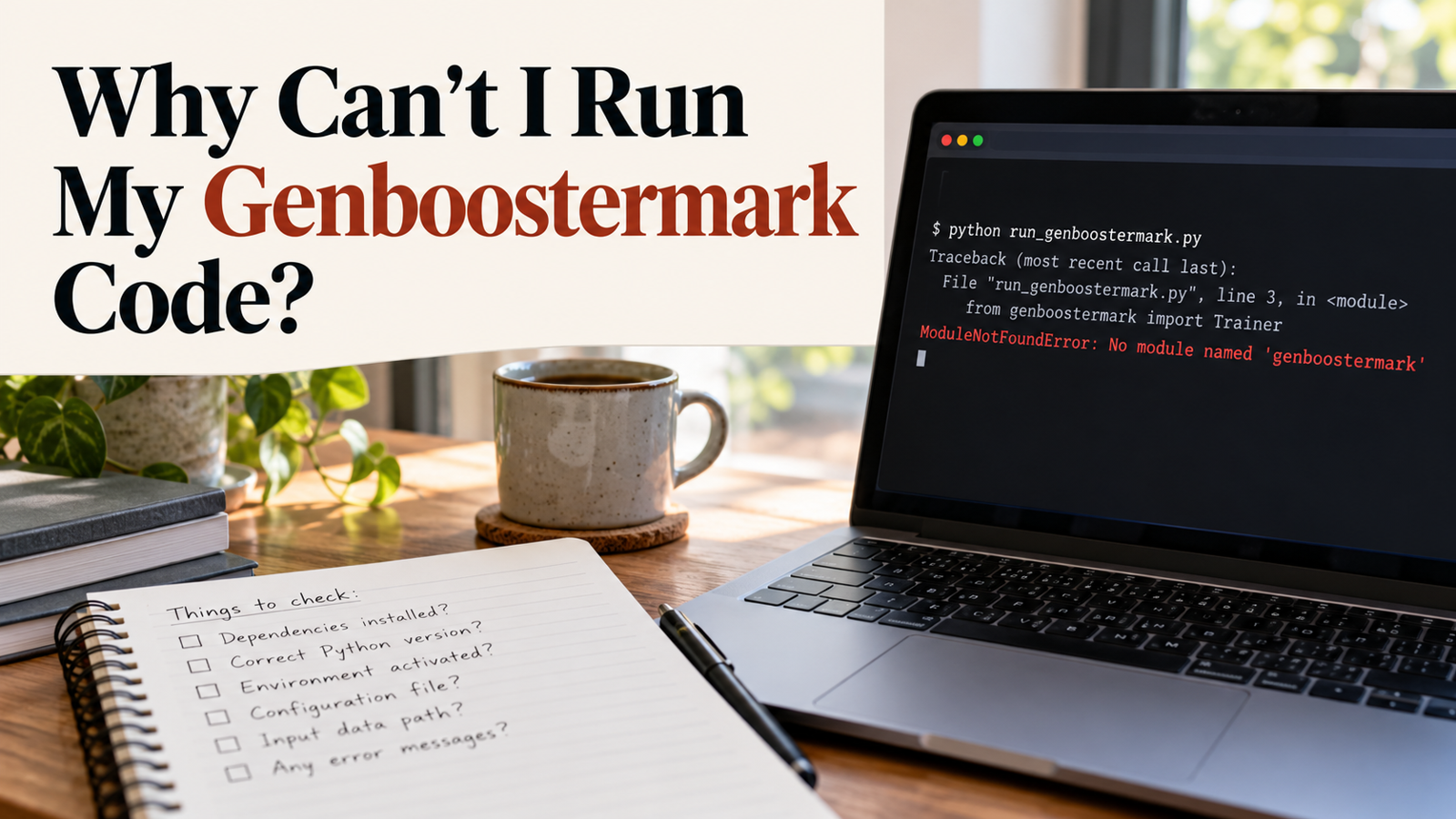
For example, a hypothetical missing-module error suggests checking the documented dependency and active environment. It does not prove that the project needs an arbitrary package called Genboostermark. An error about an input file suggests checking that file and its expected location. These examples illustrate reasoning, rather than known defects in a verified branded application.
Separate Project Packages from Other Work
For a trusted project, a virtual environment can keep its Python dependencies apart from other work on the same machine. The official venv guide describes this mechanism. It is useful for reproducibility, but it is not a security guarantee for unknown code.
Keep the project’s files outside the environment directory and follow the documented dependency list. If you later recreate the environment, you should be able to explain how its packages were chosen. An installation assembled from guessed names is harder to reproduce and provides little confidence that you are running what the author intended.
Check Inputs and Working Folders
A program may expect a sample file, a configuration document or an environment variable that was described in the setup instructions. Compare the supplied example with your local folder layout. A relative path can refer to a different place depending on where you start the program.
Use a harmless sample input when testing, and preserve a clean copy of the original configuration. Do not point an uncertain script at your only copy of important work. If the error concerns a remote service, confirm the documented endpoint and authentication method without sharing credentials with a stranger offering an instant repair.
Keep Changes Small and Reversible
Change one thing, rerun the smallest relevant test and write down the result. If you upgrade the runtime, replace the dependency list and edit the source at the same time, it becomes difficult to know which action affected the outcome. Small experiments create a clearer path to a solution.
For work involving business records or other valuable data, test in a separate copy first. A successful launch is not enough if the output is incomplete or wrong. Check a small expected result so that the test measures useful behavior rather than merely the disappearance of an error window.
When a Token or Account Code Is the Problem
If you are entering a code into a form rather than running a program, use the verified issuer’s help channel. Check the stated purpose, account and any published validity conditions. Do not invent an expiration policy or assume that a supposed server problem exists without evidence from that service.
Never pay an unofficial contact to activate a code or disclose your password so they can test it. A genuine support request should identify the service and failure while protecting the sensitive value. Code generators and unlockers are not a justified response to an ambiguous search term.
Decide Whether to Continue or Seek Better Documentation
Continue when you can identify the project, understand its requirements and reproduce a specific failure. Ask the maintainer for clarification when the instructions omit a necessary step. Provide the redacted error and your environment rather than asking them to guess what you installed.
If no trustworthy project can be identified, use a documented alternative for the underlying task. This is a practical decision about time and reliability, not proof that every page using the name is malicious. The important boundary is simple: do not treat confident online wording as a substitute for verifiable software instructions.
Frequently Asked Questions
What should I check first?
Identify what the code actually is and where it came from. Then capture the exact failing action and error.
Is a marketing website the same as a software package?
No. A website describing automation does not establish an installable product or its technical requirements.
Should I disable antivirus to make it run?
Do not disable protection for unidentified code. Verify the project and investigate the actual warning first.
Can I test with important business files?
Start with harmless sample data in a separate copy. Confirm the behavior before using valuable records.
What should I send to support?
Send the verified project link, environment details, exact command and redacted error. Keep secrets and private data out.
For related reading, our DailyNewsConsumer guide explains how to evaluate online reporting, while our ForwardingNews guide considers the checks to make before sharing an unfamiliar claim.
