

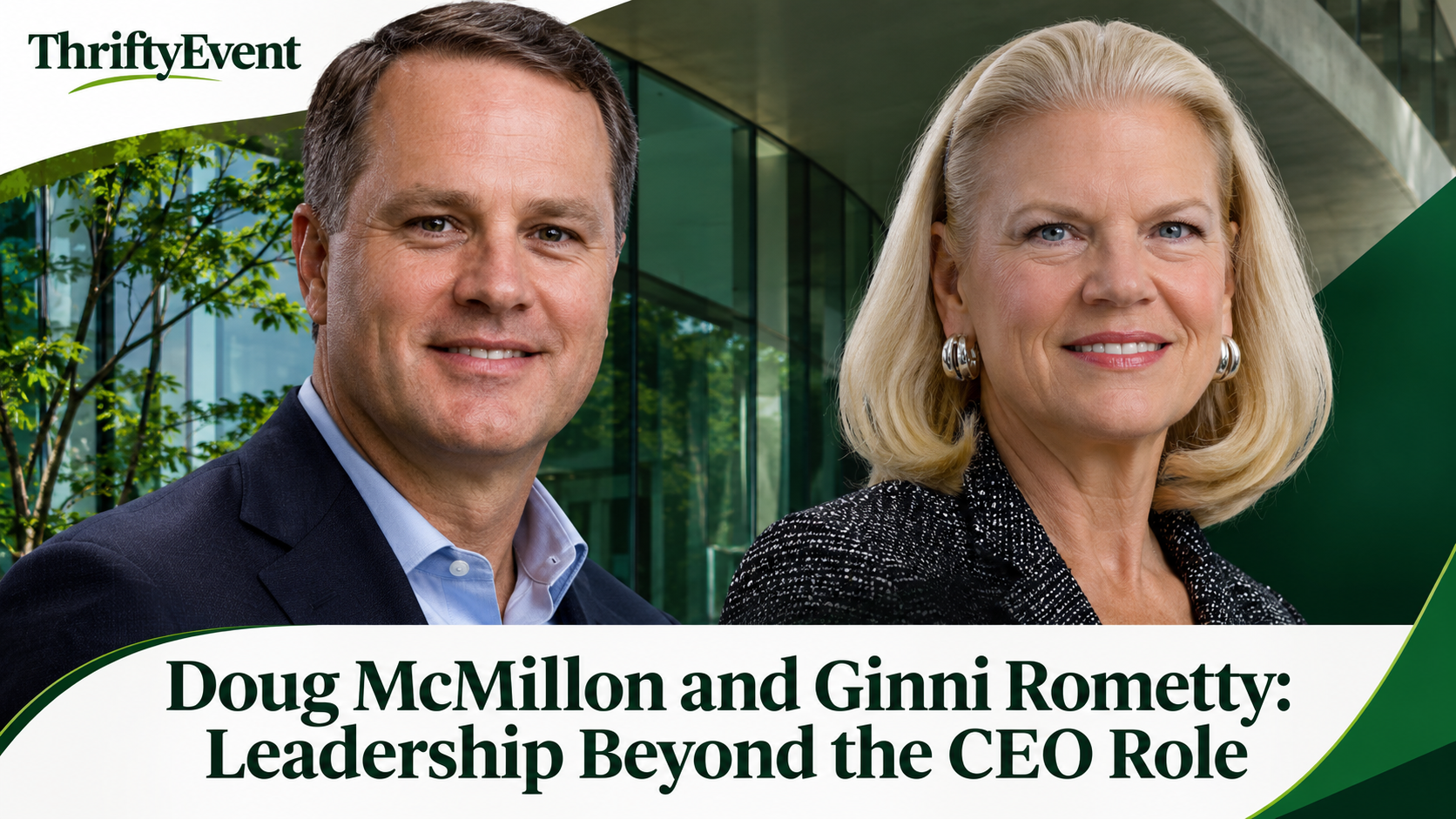
Doug McMillon and Ginni Rometty are former leaders of major American companies whose careers illuminate what happens before, during and after a CEO transition. McMillon led Walmart until January 2026; Rometty’s IBM career ended in 2020. Their comparison concerns institutional leadership and succession, not a newly announced partnership between them.
Current titles are particularly important in this pairing. An older article may accurately describe someone as chief executive at the time it was written, yet become misleading when reused years later. Starting with the verified timeline gives readers a sound foundation for comparing retail leadership with enterprise technology management.
Doug McMillon and Ginni Rometty: the timeline first
Walmart’s McMillon biography records his service as president and CEO from February 2014 through January 2026. It also traces his Walmart career to an hourly role in 1984. These details establish a long internal career rather than a recent outside appointment.
Walmart’s January 2026 leadership announcement identifies changes taking effect on 1 February 2026 under incoming CEO John Furner. Readers should therefore describe McMillon as a former CEO when discussing his position after that transition. This is a substantive correction, not merely a matter of wording.
IBM’s Rometty history records her appointment as CEO in 2012 and retirement from the company on 31 December 2020. The two careers belong to different periods and industries. A comparison should preserve those dates rather than implying that both people are currently running the companies associated with their names.
What retail leadership has to coordinate
A large retailer’s customer experience depends on many activities working together. Products have to be sourced, transported, made available and sold through usable channels. Pricing, inventory and service affect what customers actually encounter. Leadership in that setting is connected to repeated operating decisions, not just the visibility of a corporate spokesperson.
The physical and digital parts of retail also need to make sense together. A customer may research an item online, choose a delivery option or visit a store. The organisation has to connect information with the availability of real products. A convenient interface is useful only if the business behind it can fulfil the promise being made.
These are general features of retail management, not claims that one executive personally performed every task. The scale of a retailer makes collaboration central to the story. A fair profile can recognise a CEO’s responsibilities while explaining that outcomes depend on employees, suppliers, systems and external conditions as well.
What enterprise technology leadership has to coordinate
An enterprise technology company serves organisations whose operations may rely on its systems and services. Customers need continuity, support and a reason to invest in new capabilities. The sales relationship can involve technical requirements and long-term commitments. This creates a different management context from selling a product directly to a household shopper.
Change can be complicated because existing systems may remain useful and important while new ones are introduced. A company cannot assume that a customer will replace everything simply because a new strategy has been announced. The practical question is how the offering solves the customer’s problem and how the transition can be implemented.
That distinction helps explain why corporate transformation should be examined through specific actions. Acquisitions, product changes, workforce development and customer results are different parts of a record. A broad claim that a company “reinvented itself” needs supporting detail. It should not become a substitute for asking what changed and how the outcome was measured.
Succession is an organisational test
A leadership transition changes the person with ultimate executive responsibility, but the company continues serving customers. The organisation needs continuity in its operations and clarity about who makes decisions. That makes succession a useful subject in its own right, rather than simply the final paragraph of a departing CEO’s biography.
Internal succession can provide knowledge of the business, although familiarity alone does not guarantee results. The new leader still faces decisions that differ from the predecessor’s circumstances. Readers should avoid assuming either that nothing will change or that every later change is a rejection of the former leader. The evidence lies in the actual appointments, decisions and outcomes.
There can also be transitional roles after a CEO steps down. A person may remain on a board or provide advice for a defined period. Those responsibilities should be described specifically when relevant. “Retired as CEO” does not automatically mean the person has no continuing institutional relationship, just as remaining an adviser does not mean continuing to run daily operations.
How to assess a long tenure fairly
Start by defining the period. A decade-long tenure spans different economic conditions, competitive pressures and organisational decisions. A single annual result may be important without summarising the whole record. Comparing the beginning and end of a tenure can also miss changes in the business’s composition or the way financial measures are reported.
Next, separate the interests of different groups. Shareholders may focus on returns, customers on value and service, and employees on the quality and security of work. These perspectives can overlap without being identical. A balanced assessment names the measure instead of assuming that one headline number captures every form of success.
Finally, distinguish attribution from coincidence. A result occurring during a CEO’s tenure does not by itself prove that a particular decision caused it. Market conditions, earlier investments and the work of other people can all matter. Good reporting identifies documented decisions and explains the evidence connecting them to outcomes, while leaving uncertainty visible.
What their corporate scale says about personal finances
Very little can be concluded from company revenue alone. Walmart’s sales do not belong personally to McMillon, and IBM’s revenue did not belong personally to Rometty. Executive compensation, shareholdings and personal liabilities are separate categories. A useful financial profile needs evidence for each rather than substituting company scale for individual wealth.
Reported remuneration also needs context. Salary, incentives, stock-related awards and retirement arrangements can involve different dates and valuation rules. A total in a company disclosure is not automatically cash received immediately. This article avoids a personal wealth ranking because the sources used establish careers and transitions, not complete private balance sheets.
Reading leadership profiles with the right evidence
Company biographies and announcements are strong starting points for official appointments and dates. They are also the company’s presentation of its own history, so broader assessments should identify that perspective. The reader can accept a documented appointment without treating every favourable description as an independently measured conclusion.
ThriftyEvent’s commercial-review evidence guide and Newsjunctionhub.com overview provide related context on checking sources. They do not establish a joint venture involving McMillon and Rometty. The comparison here remains one of independently documented leadership histories.
Another useful check is whether the writer distinguishes the company from the sector. A retail company can perform differently from retail as a whole, and an enterprise technology provider can face circumstances unlike those of a consumer software business. Sector labels provide context, but specific claims need company-specific records. This prevents a broad industry trend from being presented as a complete explanation of an individual leader’s tenure.
Frequently asked questions
Is Doug McMillon still Walmart’s CEO?
No. Walmart records his CEO service through January 2026, with John Furner succeeding him from 1 February 2026.
Is Ginni Rometty still IBM’s CEO?
No. IBM records her retirement from the company at the end of 2020. She should be described as a former leader.
Did they run the same kind of business?
No. Walmart’s retail operations and IBM’s enterprise technology activities have different customers, operating systems and commercial requirements.
Does a CEO transition mean an immediate break with the past?
Not necessarily. Operations continue, and leadership changes can involve both continuity and new priorities. Actual decisions need to be examined rather than assumed.
Are their personal fortunes known from company sales?
No. Corporate sales, compensation and personal net worth are distinct. A company revenue figure cannot establish its former CEO’s private wealth.
