

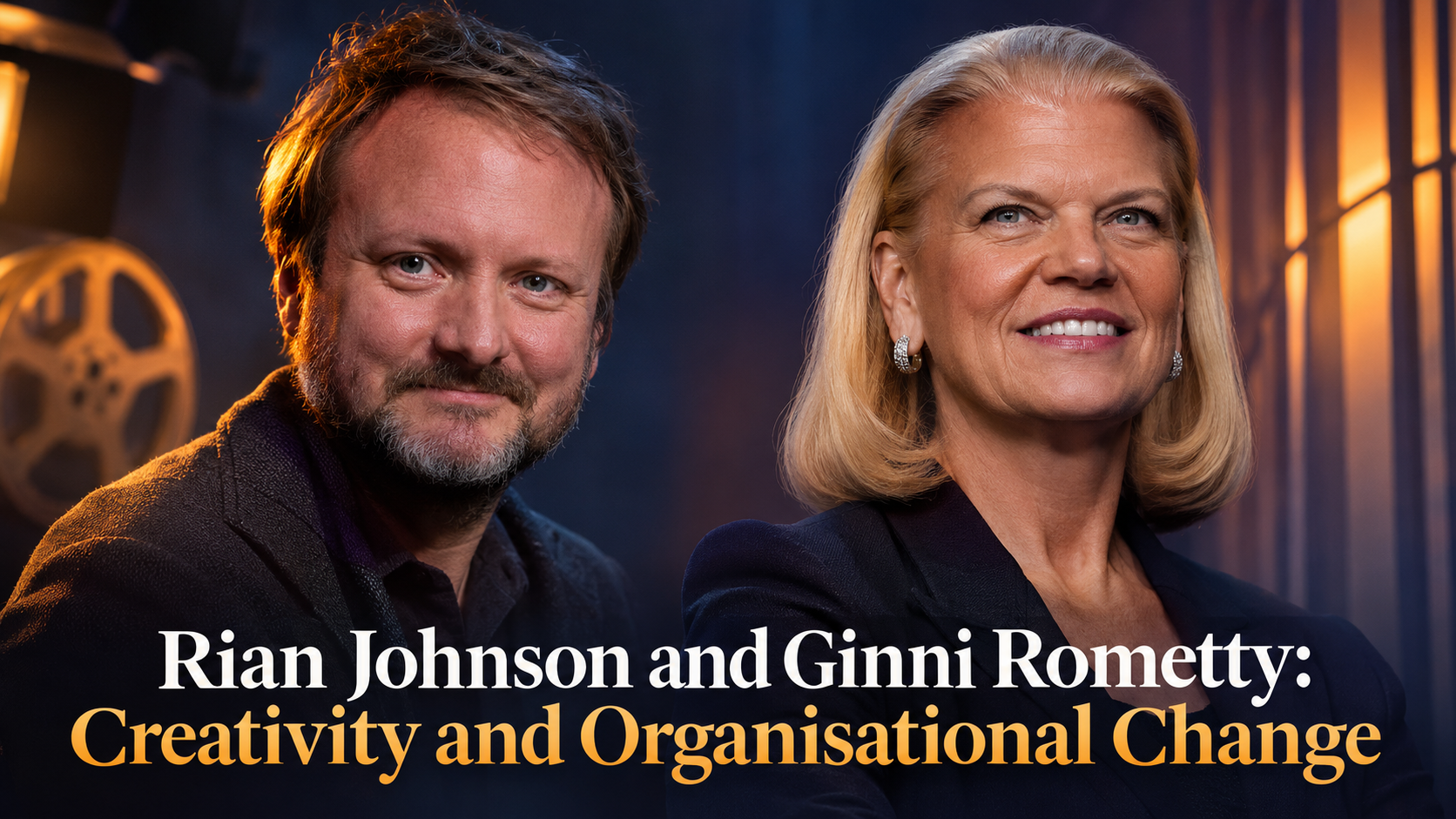
Rian Johnson and Ginni Rometty are associated with different kinds of organisational change: Johnson builds stories and film productions, while Rometty’s public career centres on enterprise technology leadership. No shared project is established by the sources reviewed here. Their careers can nevertheless be compared through collaboration, decision-making and the difference between a creative concept and a completed result.
The comparison is most useful when it stays concrete. A film director has to turn a script into a finished experience for an audience. A technology executive has to work through an organisation whose products, services and customers already exist. Both settings involve people and uncertainty, but neither can be reduced to a slogan about visionary leadership.
Two documented milestones, two different industries
Netflix’s production information for Glass Onion identifies Johnson as its writer and director. The film returned to the mystery franchise he began, with Daniel Craig again playing the detective Benoit Blanc. These are production facts, not evidence of involvement by Rometty or IBM.
For Rometty, a useful dated milestone is IBM’s acquisition of Red Hat. IBM’s completion announcement records the transaction’s closing on 9 July 2019, with a total equity value of approximately $34 billion. The agreement and its later completion are separate events; reporting the closing date avoids treating an announcement as if it had already delivered the outcome.
Rian Johnson and Ginni Rometty: the question of change
Change in a film series involves balancing recognition with surprise. Audiences may return for a familiar central character or storytelling style, but they still expect a new experience. A sequel that repeats every detail can feel unnecessary; one that abandons every point of continuity can lose the reason people were interested. This is an analytical observation about serial storytelling, not a quotation attributed to Johnson.
Change within an established technology business involves a different balance. Customers may rely on existing systems and need continuity while new capabilities are introduced. A strategic direction must therefore be translated into products, services and support that people can use. Announcing transformation is easier than demonstrating that it has improved the customer’s actual experience.
These situations are comparable at the level of questions, not identical solutions. What should remain recognisable? What needs to change? How will other people understand the transition? A director and a corporate executive may both face such questions, but the constraints, evidence and responsibilities around their answers differ substantially.
A mystery film makes structure visible
A mystery depends on the order in which information reaches the audience. A detail can appear unimportant before later events change its meaning. The viewer is encouraged to form an interpretation, reconsider it and decide which evidence deserves attention. Structure is not merely decoration; it shapes the experience of understanding the story.
This offers a useful lesson for readers of business coverage. A dramatic opening anecdote can influence how later financial information is interpreted. The reader should ask whether the evidence supports the conclusion independently of the story’s emotional force. An engaging narrative can clarify a complicated subject, but it cannot replace the need for reliable facts.
There is also a boundary between fiction and reporting. A fictional character can embody a social idea without functioning as a portrait of a specific real person. A critic can analyse that idea, but should not assert a real-world identity without evidence. The presence of technology or wealthy characters in a story does not establish a connection to a named executive.
Corporate strategy must survive implementation
A corporate acquisition is a legal and financial event, but its longer-term significance depends on what happens afterwards. Employees, customers, products and business processes must operate within the new arrangement. Readers evaluating an acquisition should therefore distinguish the transaction terms from later claims about strategic success. One does not automatically prove the other.
The distinction is particularly useful in technology, where product compatibility and customer support can matter as much as the announcement itself. A customer needs to know whether the service will continue to meet their requirements. The executive’s public explanation is relevant, but it is only one part of the evidence needed to assess the outcome.
Rometty should also be described with a current, accurate role. IBM’s historical profile records her CEO tenure from 2012 and her retirement from the company at the end of 2020. She is a former IBM leader. A profile written now should not copy a historical title as if she still holds the same executive office.
The team behind the visible leader
A film’s public identity often centres on its director and stars, but a finished production depends on many specialists. Their work includes performance, cinematography, editing, sound, production design and logistics. Recognising a director’s contribution does not require erasing those collaborators. It makes the explanation of how the work was completed more accurate.
Corporate leadership has a similar attribution problem, even though the work is different. Public communication can focus on a chief executive while operating results depend on many teams and external conditions. A fair assessment identifies the leader’s responsibilities without assigning every outcome to personal genius or failure. Organisations are more complicated than their most recognisable spokesperson.
What the comparison cannot tell us
It cannot establish a friendship, endorsement or professional partnership between Johnson and Rometty. It also cannot convert a movie’s commercial receipts into the director’s personal income or an acquisition’s value into the executive’s personal fortune. Those are different categories of information requiring different sources.
A useful financial statement must identify whose money is being discussed and what the amount measures. Production spending, distribution revenue, acquisition value and compensation are not interchangeable. This article avoids a precise personal wealth ranking because the records used here do not provide complete personal balance sheets for both individuals.
How readers can make the comparison practical
When a profile describes someone as a successful leader, ask which completed result supports the description. For a filmmaker, that might mean examining the credited work and the audience’s actual experience. For an executive, it might mean dated operating results and the implementation of a stated plan. The claim should match the evidence rather than relying on reputation alone.
ThriftyEvent’s guide to Newsjunctionhub.com and its discussion of evidence in commercial reviews offer related reading about assessing online information. They are not evidence of a shared project involving either subject. The relevant primary records remain the production information and dated company disclosures linked above.
For a reader comparing the two fields, it also helps to identify when feedback arrives. A film audience encounters a released work, although reviews and commercial results may develop over time. A corporate customer may experience an ongoing service and form a judgement through repeated use. The shape of that feedback affects what a leader can learn and when. It also explains why a launch-day reaction cannot settle every question about the lasting quality of either a creative project or a business decision. Different time frames can reveal different strengths and weaknesses without making the earlier evidence irrelevant.
Frequently asked questions
Did Rian Johnson and Ginni Rometty collaborate?
The sources examined here do not establish a collaboration. Their work is compared through separate documented careers.
What was Rian Johnson’s role on Glass Onion?
Netflix’s production information identifies him as the writer and director of Glass Onion: A Knives Out Mystery.
Is Ginni Rometty still IBM’s CEO?
No. IBM identifies her as a former leader and records her retirement from the company at the end of 2020.
When did IBM complete the Red Hat acquisition?
IBM announced completion on 9 July 2019. Its announcement described the total equity value as approximately $34 billion.
Does a company’s acquisition value measure its CEO’s wealth?
No. It describes a corporate transaction. An executive’s personal assets, liabilities and compensation require separate evidence.
