
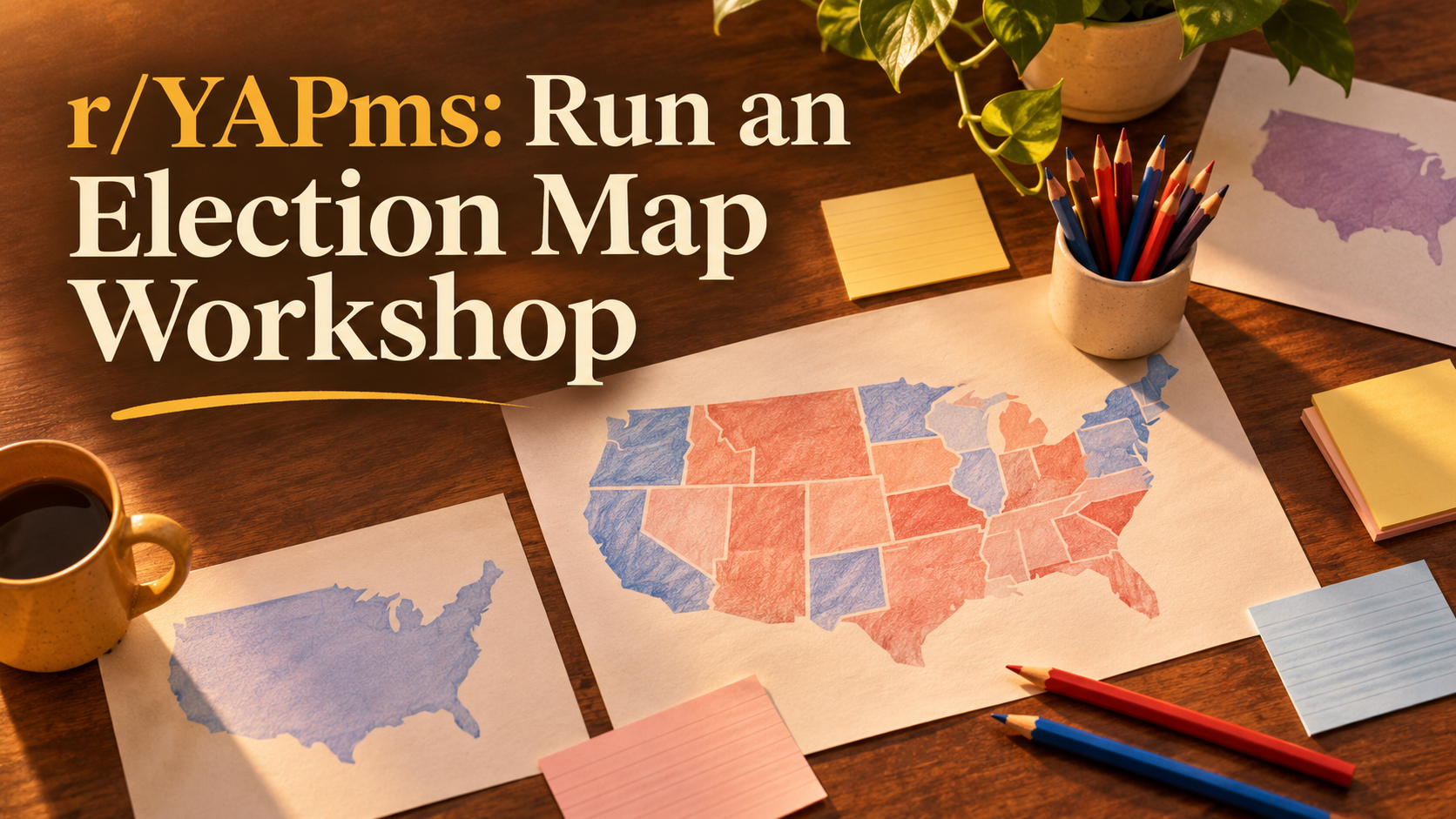
r/YAPms can provide discussion material for an election-map workshop, but a successful session needs a clear learning goal. Use community examples to practise explaining assumptions and interpreting maps, rather than asking a group to treat online predictions as established electoral facts.
A workshop can be simple: a shared screen, a few printed questions and a facilitator who keeps the conversation focused. You do not need expensive software or a competitive atmosphere. The aim is for participants to leave better able to explain what a political map shows, what it leaves out and how its creator reached a conclusion.
Define a Useful Outcome Before Choosing Examples
Decide whether the session is about geography, evidence or scenario building. These subjects overlap, but trying to cover all of them equally in a short meeting can leave beginners confused. Write a one-sentence outcome such as: participants will be able to distinguish a historical result from a hypothetical election map.
Then choose examples that serve that outcome. A complicated map with many unexplained categories may be interesting to experienced enthusiasts while being unsuitable for a first session. Prefer an example whose title, legend and underlying question are clear enough to discuss without a lengthy introduction.
The r/YAPms community is one place to discover maps and discussion. The associated YAPms platform offers a map library for exploring electoral geography. Check the current interface before your session instead of assuming that an old tutorial still matches it.
Keep the Budget Focused on Participation
Start with equipment you already have. One readable screen may be enough for a small group, while printed notes can help people who prefer to work away from the display. Test whether everyone can see the legend and place names from their actual seat, not just from the presenter’s position.
Avoid spending on decorative materials that do not support the learning task. A clear handout with space for assumptions and questions is usually more useful than elaborate party-coloured props. If refreshments are provided, keep them separate from the work area so that people can handle shared materials comfortably.
Plan an offline alternative. Save permitted teaching notes and prepare a blank exercise sheet in case the connection fails. The backup should support the same learning goal without requiring you to invent election figures or improvise unsupported claims in front of the group.
Establish a Neutral Discussion Agreement
Explain that the workshop evaluates evidence and map design rather than participants’ political identities. People may disagree about an outcome without being asked to defend a party or candidate. Give everyone permission to say that they do not yet understand a term or that a source is missing.
Ask participants to describe an argument before criticising it. If a map assumes a particular change in turnout, the first task is to identify that assumption. The second is to discuss whether it is justified. Combining the two steps can turn an analytical exercise into a contest over personal preferences.
Keep the discussion agreement short enough to remember. Respectful language, clear sourcing and a willingness to distinguish fact from speculation are practical expectations. You can remind the group of those expectations when the conversation drifts without turning the session into a formal debate tournament.
Use a Three-Round Exercise
In the first round, show a map without asking anyone to predict the winner. Ask participants to identify the election, year, units and legend. Record unanswered questions. This demonstrates how much information is necessary before an image can be interpreted responsibly.
In the second round, provide the creator’s explanation. Ask each small group to write down one supported observation and one assumption. For example, the map might use a stated historical baseline while making a personal judgement about future movement. The point is to classify the statements accurately, not to reward the strongest opinion.
In the third round, change one hypothetical assumption and ask what would need to be reconsidered. Keep this clearly labelled as an exercise. A group can explore how sensitive an argument is without claiming that the altered scenario is a professional forecast.
Match the Exercise to the Electoral System
Avoid mixing systems without explanation. A map about one office may count outcomes differently from a map about another. Establish what the relevant total represents before participants compare colours or discuss who would win under the scenario.
For a US presidential example, the National Archives’ Electoral College resource provides the institutional reference. Use the original source to clarify the process, then return to the workshop’s map. The map is an educational representation, not the legal record itself.
If your group is unfamiliar with the system, simplify the task rather than rushing through an explanation. You might compare two fictional scenarios on the same map and leave institutional detail for a later session. Label fictional figures prominently so nobody photographs the exercise and mistakes it for a real result.
Give Every Participant a Role
Small groups can divide attention between the map, the source and the explanation. One person reads the legend, another identifies the evidence and a third summarises the uncertainty. Rotate roles so the most experienced participant does not perform every task.
Offer alternatives for people who find dense visual material difficult. Read categories aloud, provide a text summary and avoid making colour the only way to identify a distinction. Ask what format would help before the session where possible. Accessibility is easier to plan than to improvise after someone has been excluded.
Do not make speed the measure of success. A participant who notices an unclear label has made a valuable contribution even if another group finishes first. Reward explanations that other people can follow, including explanations of why an answer cannot yet be established.
Finish With a Reusable Record
Ask each group to produce a short note containing the map’s question, the evidence used, its main assumption and one unresolved issue. This record is more useful than a photograph of the final colours alone. It preserves the reasoning that the image cannot communicate by itself.
For your own review, record which instructions were unclear and where the discussion became unfocused. Improve the next session around those observations. You do not need to collect participants’ political preferences to assess whether the workshop taught its intended skill.
Our practical news-reading routine can support a follow-up session about sources. If you use simple scripts for workshop administration, our guide to handling errors in event scripts offers a separate practical topic for organisers.
Frequently Asked Questions
Is r/YAPms suitable for a beginner workshop?
It can supply examples, but the facilitator should review each one in advance. Choose material with a clear purpose and avoid assuming that a lively discussion is also a well-documented teaching resource.
How many maps should a short session use?
Use as few as the learning goal requires. Two well-explained examples can generate a better discussion than a long slideshow. Leave enough time for participants to articulate assumptions and ask questions.
Do participants need Reddit accounts?
Design the session so that participation does not depend on posting or interacting with strangers online. Use appropriate public material and prepared notes. Check access and any relevant terms before the event.
Should the workshop pick a winning prediction?
Only if that serves a clearly defined exercise, and keep hypothetical judgements labelled. A more useful beginner outcome is being able to explain why two maps differ and what evidence would help evaluate them.
What if the group becomes partisan?
Return to the stated task and ask which source or assumption is under discussion. Give participants a concrete question to answer together. If the exchange remains unproductive, move to a different example or take a break.
